


UK Car dent Repair Cost: A Complete Guide
Finding a dent on your car is always a frustrating moment, and the first question that pops into your head is usually, "How much is this going to cost me?"
In the UK, a straightforward, small dent repair will typically set you back somewhere between £75 and £250. Think of this as the baseline. The final price tag can climb quite a bit depending on just how bad the damage is and which repair method is needed to make it right.
What's the Average Car Dent Repair Cost in the UK?
There's no single, one-size-fits-all price for dent removal. Instead, the final quote is built from several different factors, almost like a recipe. The cost spectrum is wide because the damage itself can range from a tiny ding picked up in a car park to a much more serious crease across a whole panel.
The most obvious factor, of course, is the size of the dent. A little knock, maybe the size of a 10p coin, will naturally sit at the cheaper end of the scale. But as the dent gets bigger and deeper, the job becomes more complex and time-consuming, which is reflected in the bill.
Common Damage and Their Typical Price Ranges
To give you a better idea of what to expect, let's look at some real-world figures. On average, repairing a dented panel in the UK costs between £220 and £450. This number can shift based on a few key details.
Minor cosmetic issues like simple paint scuffs might be sorted for around £150. Deeper scratches, though, need more attention and average closer to £210. Bumper repairs are a bit different; they can be charged by the hour at roughly £60, or you might get a fixed quote that could go as high as £810 if the damage is particularly nasty.
Every repair is unique. A good technician doesn't just look at the dent; they assess its effect on the whole panel and the paintwork. You can find out more about what goes into these prices by exploring how to get an estimate for car repairs.
A high-quality repair does more than just restore your car's looks—it protects its value. Ignoring damage, especially where the paint is broken, is an open invitation for rust, which leads to much bigger and more expensive problems down the road.
Key Factors That Drive the Price Up (or Down)
So, what are the things that actually determine your final quote? Understanding these will help you make sense of why one price might be so different from another.
Where the dent is: A dent on a flat, easy-to-reach spot like a door is much simpler to fix than one on a sharp body line, a curved wheel arch, or a reinforced roof rail. Access is everything.
The state of the paint: If the paint has not been cracked or chipped, a fantastic technique called Paintless Dent Repair (PDR) can often be used. It's faster and cheaper. But if the paint is damaged, the process becomes more involved, requiring sanding, filling, priming, and perfect colour-matching.
The car itself: Your car's make and model play a big role. Parts for luxury, high-performance, or classic cars are often more expensive, and working on them can require specialist tools and expertise.
To help you visualise this, here's a table summarising the estimated costs for different types of damage.
Estimated UK Car Dent Repair Costs by Size and Type
This table breaks down the typical cost ranges you can expect for various types of car bodywork damage, from minor scuffs to more significant dents.
Type of Damage | Average Cost Range (£) |
|---|---|
Minor Scratches & Scuffs | £75 - £150 |
Small Dents (No Paint Damage) | £75 - £200 |
Medium Dents (With Paint Damage) | £200 - £400 |
Large or Complex Dents | £400+ |
As you can see, the price escalates as the damage becomes more complex and involves paintwork. A small ding that has not broken the paint is a relatively quick fix, while a large dent requiring a full respray is a much bigger job.
What Factors Determine Your Final Repair Bill?
While average prices offer a good ballpark figure, your final car dent repair cost is never one-size-fits-all. No two dents are ever truly the same, and a good technician needs to assess several key details before they can give you an accurate quote. Getting to grips with these factors will help demystify the pricing and show you exactly why one repair can be so much cheaper than another.
This image shows how a technician sizes up the damage to work out the complexity and, in the end, the cost of the job.
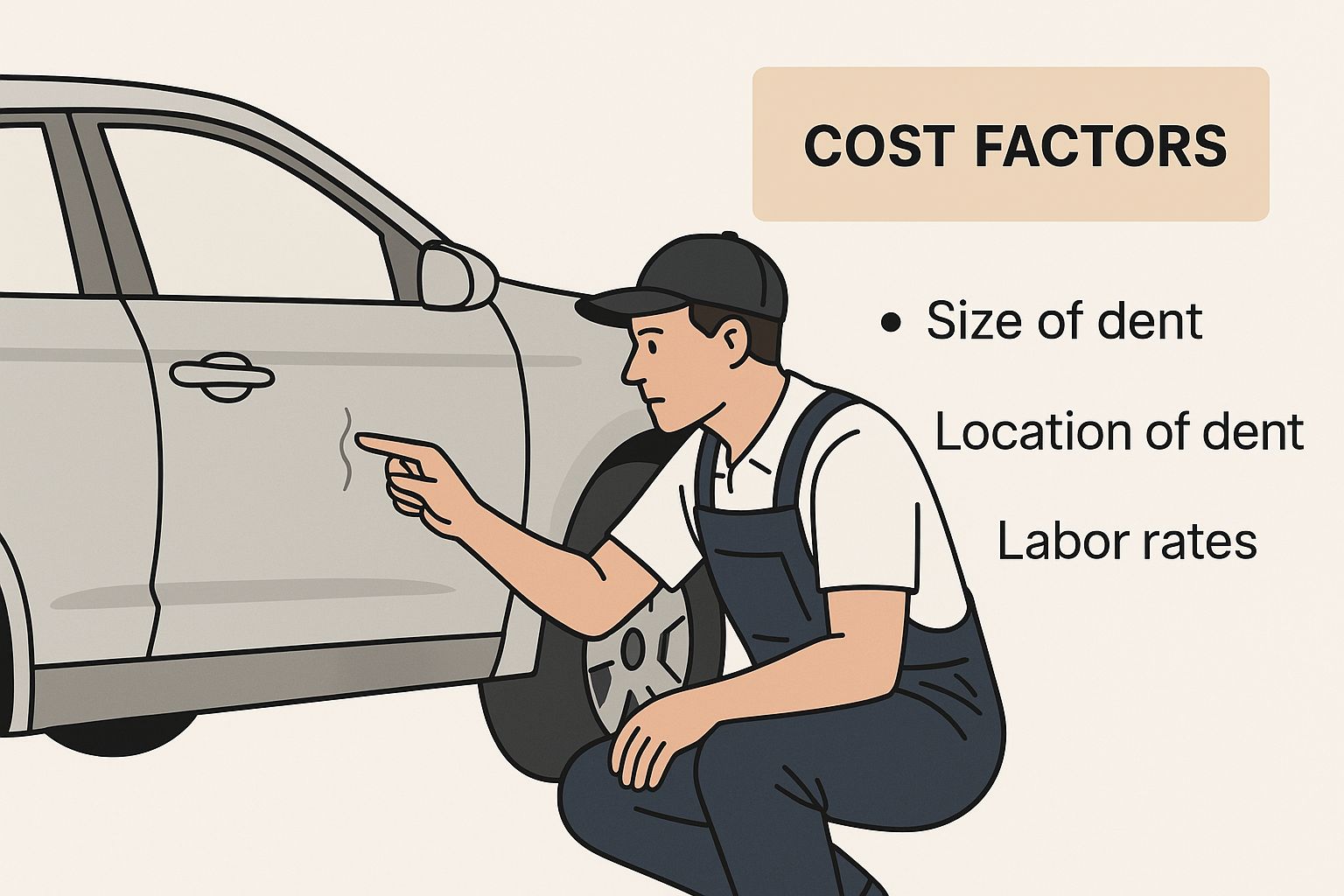
As you can see, the assessment goes well beyond just the dent's size. It’s a full-on diagnosis, taking into account the panel material, location, and paint condition to build a complete picture of the work involved.
The Dent Itself: Size and Depth
The most straightforward factor driving the cost is the physical size and depth of the dent. A small, shallow ding the size of a five-pence piece is a relatively simple fix. But as the dent grows in diameter and sinks deeper, the amount of work required increases dramatically.
Think of your car's metal panel like a piece of fabric. A gentle pull leaves a minor wrinkle you can easily smooth out. A sharp, deep impact, in contrast, stretches the material, making it much tougher to return to its original, flat state. A deep crease might have stretched the metal too far, which ramps up the labour time and the skill needed for a flawless finish.
Where the Dent Is Located
Location is just as crucial as size. A dent on a large, flat surface—like the middle of a door panel—is usually the most straightforward and affordable to repair. Technicians can get good access to the area from behind, allowing them to gently massage the metal back into its proper shape.
The cost starts to climb when the damage is in a more awkward spot.
Body Lines: These are the deliberate creases and style lines designed into your car’s bodywork. Dents on these lines are tricky because the technician has to perfectly recreate that sharp, precise contour. It's a real art form.
Panel Edges: The edges of doors, bonnets, or boot lids are often double-skinned or reinforced for strength. This limits a technician's access, sometimes turning what looks like a simple dent into a genuine challenge.
Difficult-to-Access Panels: A dent on a roof rail or a quarter panel (the bit around the rear wheels) can be a nightmare to reach from behind. This often means more time and specialised tools are needed, which naturally adds to the final bill.
Panel Material: Aluminium vs. Steel
The type of metal your damaged panel is made from plays a huge role in the repair cost. Most car panels are made of steel, which has a sort of "memory" and tends to pop back to its original shape with skilled manipulation.
Aluminium, on the other hand, is a different beast. It's often used in higher-end or performance cars to save weight. While it's lighter and stronger than steel, it has less memory and is more prone to stretching or tearing when dented. Repairing aluminium requires special training and tools to gently work the metal without causing it to crack. This added complexity means fixing a dent on an aluminium panel will almost always cost more than an identical dent on a steel one.
Key Insight: An aluminium bonnet or door panel can increase the repair cost by 25% to 50% compared to a steel equivalent, simply because the material demands a much higher level of skill and care.
The Condition of Your Paintwork
The state of your car’s paint is the major fork in the road that determines the repair method and cost. If the paint surface is totally intact—no chips, cracks, or deep scratches—a technician can often use Paintless Dent Repair (PDR). This technique is far less invasive, much quicker, and significantly cheaper.
If the impact has broken the paint, the job gets a lot more involved. The repair now requires a full-on, multi-step process:
Sanding the damaged area down to the bare metal.
Applying filler to smooth out the surface.
Using primer to prepare the panel for paint.
Carefully colour-matching and spraying the new paint.
Applying a clear coat to protect the finish and match the factory shine.
This traditional body shop approach is far more labour-intensive and uses a lot more materials, leading to a much higher final cost. For more ideas on keeping these expenses in check, take a look at our guide on how to save on car repairs with smart tips for all drivers.
Comparing Paintless Dent Repair and Traditional Methods
So, your car has a dent. When it comes to getting it fixed, you’re basically looking at two different paths. The route you choose will be the single biggest decider on both the final car dent repair cost and how long you’ll have to be without your car. These two distinct approaches are Paintless Dent Repair (PDR) and the more conventional work you’d find at a body shop.
Getting your head around the difference between these two is the best way to understand what you’re paying for and why one quote might seem worlds apart from another. Let’s break each one down – how it works, what it costs, and when it’s the right tool for the job.
The Magic of Paintless Dent Repair
Paintless Dent Repair, or PDR as it’s known in the trade, is a bit of an art form. It’s a highly skilled technique that removes dents without ever touching your car's original paintwork. The best way to picture it is as a sort of reverse metal sculpting. A specialist technician uses a whole host of special tools to get behind the dented panel and very carefully massages the metal back into its original form.
This technique is absolutely ideal for all those annoying little dings and dents you pick up where the paint itself has not been broken.
Shopping trolley dings: The classic car park wound.
Minor door bumps: When another driver gets a bit too friendly next to you.
Hail damage: For the unfortunate event of a hailstorm, PDR is the go-to for fixing dozens of small dents efficiently.
Because there’s no sanding, no filler, and no respraying involved, PDR is drastically faster and cheaper than a traditional repair. A good PDR technician can often have a small dent sorted in less than an hour. It also preserves your vehicle's factory finish, which is a massive bonus when it comes to resale value.
When Is PDR the Right Choice?
PDR is a fantastic, almost miraculous solution, but it can’t fix everything. It really shines under a specific set of circumstances.
The perfect candidate for PDR is a fairly shallow dent on a standard steel or aluminium panel where the paint is completely intact. If the metal is sharply creased or the paint is cracked and flaking, you’re almost certainly going to need a different approach.
Estimating PDR costs has become quite scientific. Some garages now use advanced software to give precise quotes. For instance, straightforward dents under 140 mm that are not on a sharp body line can often be repaired for between £60 and £200+. For bigger or trickier dents that need extra work like glue pulling, the price might range from £120 to £500 or more. As the technique completely avoids repainting, it's a huge factor in keeping the price down, with a skilled technician able to restore a panel in just a few hours. You can find out more about how these repair prices are calculated to get a better idea.
Traditional Body Shop Repairs Explained
When a dent is just too severe for PDR, or if the paint is chipped, cracked, or badly scratched, it’s time for a traditional body shop repair. This is a much more involved, multi-stage process designed to restore panels that have suffered some serious trauma.
This method typically follows several key steps:
Sanding: First, the damaged area is sanded right back to the bare metal.
Filling: A body filler is then applied to completely smooth out the indentation.
Priming: The filled area is then primed to protect the raw metal and get it ready for new paint.
Painting: The technician uses computer-matched paint to perfectly blend the repair with the rest of the panel.
Finishing: Finally, a clear coat is applied over the top to match the factory gloss and protect the fresh paint.
As you can see, this is a far more labour-intensive job that uses more materials than PDR, which is exactly why it costs more. But it's the only real solution for deep creases, large dents that have stretched the metal, and any damage where the protective layer of paint has been broken, leaving the panel vulnerable to rust.
How Repair Costs Vary Between Different Car Panels
Not all dents are created equal, and where one pops up on your vehicle plays a massive role in the final car dent repair cost. It helps to think of your car's bodywork not as one single shell, but as a collection of different parts. Each has its own unique shape, material, and—most importantly—its own level of accessibility for a technician.
A dent on one panel might be a simple, straightforward fix. An identical one somewhere else? That could be a much bigger, more complex job altogether.
Understanding these differences is the key to making sense of any quote you receive. A good technician doesn't just see a dent; they see its location and all the potential complications that come with it. Let's break down how the price can shift so dramatically from one panel to the next.
Car Doors: The Most Common and Accessible Area
Car doors are the usual suspects when it comes to dents. Whether it's a tight spot in a car park or a runaway shopping trolley, they seem to attract trouble. The good news? They're often the most straightforward and least expensive panels to get sorted.
The main reason for this is accessibility. Technicians can usually remove the interior door trim, which gives them direct access to the back of the dent. This is perfect for Paintless Dent Repair (PDR), where they use special tools to gently massage the metal from behind without needing to touch the paintwork. That direct access makes the job quicker and simpler, which helps keep labour costs down.
Bumpers: A Story of Plastic and Sensors
Bumpers are designed to absorb minor impacts, but fixing them is a completely different ball game compared to metal panels. Most modern bumpers are made of plastic, which demands specific repair techniques. What's more, they are often packed with sensitive technology.
A simple scuff or a shallow dent on a basic bumper is usually a fairly low-cost fix. The trouble really starts when the bumper is home to parking sensors, cameras, or the radar systems that run your driver-assistance features.
Sensor Complications: A knock that seems minor can easily damage these sensitive electronics or throw them out of alignment.
Recalibration Needs: After the repair, these systems must be perfectly recalibrated to function correctly and safely. This is a specialist job that adds significant time and cost.
Replacement vs Repair: Deep cracks or damage near sensor mounts often mean the entire bumper has to be replaced, which is far pricier than a simple repair.
Bumper repair costs in the UK can vary wildly. Light scuffs might be £100 to £200, while dents could range from £150 to £300. Cracks can easily push the bill towards £400. Full replacements, especially on cars loaded with advanced sensors, can jump from £400 to over £800. With typical UK body shop labour charges at £50 to £80 per hour, and extra costs for specialist tasks like plastic welding, you can see how the final price is calculated.
Bonnets and Boot Lids: Large Panels with Hidden Challenges
At a glance, bonnets and boot lids look like they should be easy to repair—they're just big, flat-ish panels, right? While that can be true for small dings right in the centre, they come with their own set of challenges that can quickly drive up the cost.
The problem lies underneath. Both panels have a complex understructure of bracing and sound-deadening material. If a dent lands on one of these reinforced areas, it becomes extremely difficult to access from behind. In these cases, technicians might have to use glue-pulling PDR techniques from the outside, which takes a huge amount of skill and patience. A large dent on a bonnet can also affect its alignment with the wings, adding another job to the list.
Key Takeaway: The dent's position relative to the hidden support braces beneath a bonnet or boot lid is a critical cost factor. What looks like an easy fix on the surface can be complicated by what you cannot see.
Wings and Quarter Panels: Curves and Creases
The front wings (the panels over your front wheels) and the rear quarter panels introduce another level of difficulty. These areas aren't flat; they're defined by complex curves, swooping lines, and sharp creases that are part of the car's design.
Recreating those precise contours after they've been dented is a real art form. A technician can't just push the metal flat; they have to meticulously sculpt it back to its factory-original shape. Rear quarter panels are particularly tough because they are a welded part of the car's main structure, meaning there's virtually no access from behind. This often makes traditional repair methods, involving filler and fresh paint, the only realistic option. Our guide on cost-effective car repair tips for 2025 can help you manage these sorts of expenses.
Roof Panels: The Toughest Repair Job
A dent on the roof is often the most challenging and expensive repair of them all. Roof panels are large, heavily braced, and offer very limited access. To even attempt a repair from behind, the headlining inside the car has to be carefully removed and reinstalled—a labour-intensive job in its own right.
It gets even worse if the dent is near the edge of the roof, on the reinforced roof rail. These areas are critical for the car's structural safety in a rollover, so any repair has to be absolutely perfect. For these reasons, a roof dent that might seem minor at first glance can quickly become one of the most costly fixes you'll face.
Choosing Between DIY Kits and Professional Repair
So, you’ve found a dent in your car. Your first thought might be to jump online, grab a DIY kit, and save a few quid. It seems like a simple, cost-effective fix, right? Before you click "buy," it’s worth taking a moment to properly weigh the potential savings against the risks. The choice between a quick home fix and calling in the experts can make a huge difference to your car's appearance and your wallet.

Let's break down what each option really means for you and your vehicle.
The Appeal and Reality of DIY Dent Kits
DIY kits look like a fantastic bargain, with some costing as little as £20. You’ll generally find two types: suction cup pullers and glue-pull systems. The suction cup ones create a vacuum to pop the dent out, while glue-pull kits use hot glue to stick a tab to the dent, which you then use to pull the metal back into shape.
On the face of it, they’re sold as an easy fix for minor dings. And sometimes, for a very small, shallow dent on a flat panel where the paint is perfect—think a light tap from a stray football—they can actually work.
The Hidden Risks of a DIY Repair
But that low price tag comes with some serious hidden risks. If you do not have the right touch, it’s incredibly easy to make things worse. A classic mistake is yanking too hard, creating a sharp high spot that's far more difficult and expensive to fix than the original dent ever was.
Even worse, you could damage your paintwork. Pulling too aggressively with a glue tab or using a suction cup incorrectly can easily crack, chip, or flake the paint. Suddenly, what was a simple cosmetic issue has become a much bigger job needing professional sanding, filling, and repainting. Any money you thought you were saving is gone in an instant.
A failed DIY attempt often leads to a higher professional repair bill. Technicians frequently have to correct botched jobs before they can even begin to fix the original dent, adding extra labour and cost.
Why Professional Repair Offers Peace of Mind
Hiring a professional might seem more expensive upfront, but what you’re really paying for is experience, specialist tools, and a guaranteed result. A skilled technician has spent years learning how to "read" metal, understanding precisely how to massage a panel back to its factory-fresh state without causing more damage.
Here’s what you get with a pro:
Expertise and Experience: A technician will assess the dent’s size, depth, and location to choose the right method, whether that's Paintless Dent Removal (PDR) or a more traditional body shop repair.
Specialised Tools: Professionals have an arsenal of high-quality gear, from finely crafted PDR rods and specialised lights to advanced paint-matching technology.
Guaranteed Quality: A reputable garage will stand by its work. You’ll get a flawless, often undetectable finish that protects your car’s resale value.
Going professional takes the guesswork and the risk of costly mistakes out of the equation. For anyone serious about keeping their car looking its best, our **2025 car bodywork repair tips for everyday drivers** offer even more advice. The choice really boils down to this: a small potential saving, or the security of a perfect, lasting repair.
Should You Claim for a Dent Repair on Your Insurance?
Figuring out whether to get your insurance company involved after a dent can feel like a bit of a financial tightrope walk. At its core, the decision comes down to a simple bit of maths: comparing your policy excess to the final car dent repair cost.
If a body shop quotes you £350 for the work but your policy excess is £500, the answer is easy. Paying out of pocket is the only sensible choice. Making a claim would mean you pay the full repair cost yourself anyway, plus you’d have the claim logged against your policy. It only really starts to become a viable option when the repair bill climbs significantly higher than your excess.
Weighing the Impact on Your Premiums
Before you pick up the phone to your insurer, you need to think about the long-term financial picture. Making a claim, even for a relatively small dent, will almost certainly see you lose some, if not all, of your No Claims Bonus (NCB) if you have not specifically paid to protect it.
Losing years of carefully built-up NCB can cause a painful spike in your annual premium for years to come. That short-term win of having the insurer pay for the repair could easily be cancelled out by inflated insurance costs down the line. You have to ask yourself: is the immediate cash saving worth paying higher premiums for the next three to five years?
The Rule of Thumb: Many drivers find that for any repair under the £500-£700 mark, paying for it themselves is the shrewder long-term move. It keeps their claims history clean and their future premiums predictable.
The Claims Process Explained
If you do decide that making a claim is the right move, the process is fairly straightforward, but it helps to know what to expect. First, you'll need to contact your insurer to report the damage, providing all the details and usually some photos as evidence. They will then ask you to get at least one professional quote for the repair.
From there, you generally have a couple of choices on where to get the work done:
Insurer-Approved Garages: Your insurance provider will have its own network of recommended repairers. Using one of these can make life easier, as the garage often bills the insurer directly, simplifying the whole process.
Your Chosen Garage: You always have the legal right to take your car to a garage of your choice. This is a great option if you have a local specialist you trust to do a top-notch job, though you might have to pay the bill upfront and claim the money back from your insurer.
Once your insurer has the quote and gives the repair the green light, you can book your car in. When the work is finished, you’ll pay your excess directly to the garage upon collection, and your insurer settles the remainder of the bill.
Got Questions About Car Dent Repair Costs?
When you're staring at a fresh dent in your car, a lot of questions probably pop into your head. It helps to get a handle on the key details, so to wrap things up, here are some straight answers to the things we get asked most often.
How Long Will a Dent Repair Actually Take?
This really comes down to the type of damage and the method used to fix it. If it's a small, simple ding and we can use Paintless Dent Repair (PDR), you could be in and out in under an hour. It’s a remarkably quick process for the right kind of dent. For a medium-sized dent, a good technician will likely need 2-3 hours to massage the panel back to perfection.
Traditional repairs that involve filling, sanding, and painting are a different story altogether. That’s a multi-stage process, and you cannot rush it. Your car will probably need to stay at the body shop for a few days to make sure each layer of paint has enough time to cure properly.
Will Fixing a Dent Hurt My Car's Value?
Quite the opposite! A professional, high-quality repair will actually protect your car's value. Leaving a dent or scrape unfixed is what really brings the value down. By getting it fixed properly, you’re restoring the car to its original condition and preserving its appeal for any future sale.
The real danger to your car's value comes from a botched job. A poorly done DIY attempt or a cheap, unprofessional repair with mismatched paint or a lumpy finish will stick out like a sore thumb to a buyer or an appraiser.
Can Paintless Dent Repair Fix Everything?
Unfortunately, no. PDR is a fantastic technique, but it has its limits. It works best when a few key conditions are met:
The original paintwork must be completely intact—no cracks, chips, or flakes.
The dent can't be located on a really sharp, defined body line.
The damage isn't on the very edge of a panel where the metal is double-skinned.
If a dent is especially deep or has a sharp crease, the metal has likely been stretched too far for PDR to work its magic. In those cases, a traditional body shop repair is the only way to get the panel looking right again.
Is a Mobile Dent Repair Service Cheaper?
Often, yes. Mobile repair services usually specialise in PDR and can be a more budget-friendly option for smaller dings. They do not have the same overheads as a physical body shop, plus you get the convenience of them coming to you.
For those minor car park dings where the paint is not broken, a mobile service is a great shout. For anything bigger or any damage that needs painting, you’ll need the tools and controlled environment of a proper body shop.
If you're dealing with a dent or scratch and want honest advice and a flawless finish, we’re here to help. Krause Autos provides expert bodywork services in Sandy, Bedfordshire, treating every vehicle with precision and care. Get in touch today for a free, no-obligation quote!


Comments