


Find a Full Service Garage Near Me a UK Driver's Guide
- coledem
- Aug 9, 2025
- 10 min read
When you type “full service garage near me” into a search bar, you’re looking for a long-term partner for your vehicle’s health. It’s not just about finding a place for a quick oil change; it's about locating a one-stop shop that can handle everything from routine maintenance and annual MOTs to tricky electrical diagnostics and major mechanical repairs.
A genuine full-service garage aims to build a lasting relationship with you, getting to know your car inside and out. This makes car ownership much simpler. Instead of juggling different specialists for different problems, you have a single, trusted point of contact you can rely on for anything that comes up.
The image below gives a snapshot of the most common jobs garages tackle, showing what most drivers typically need.
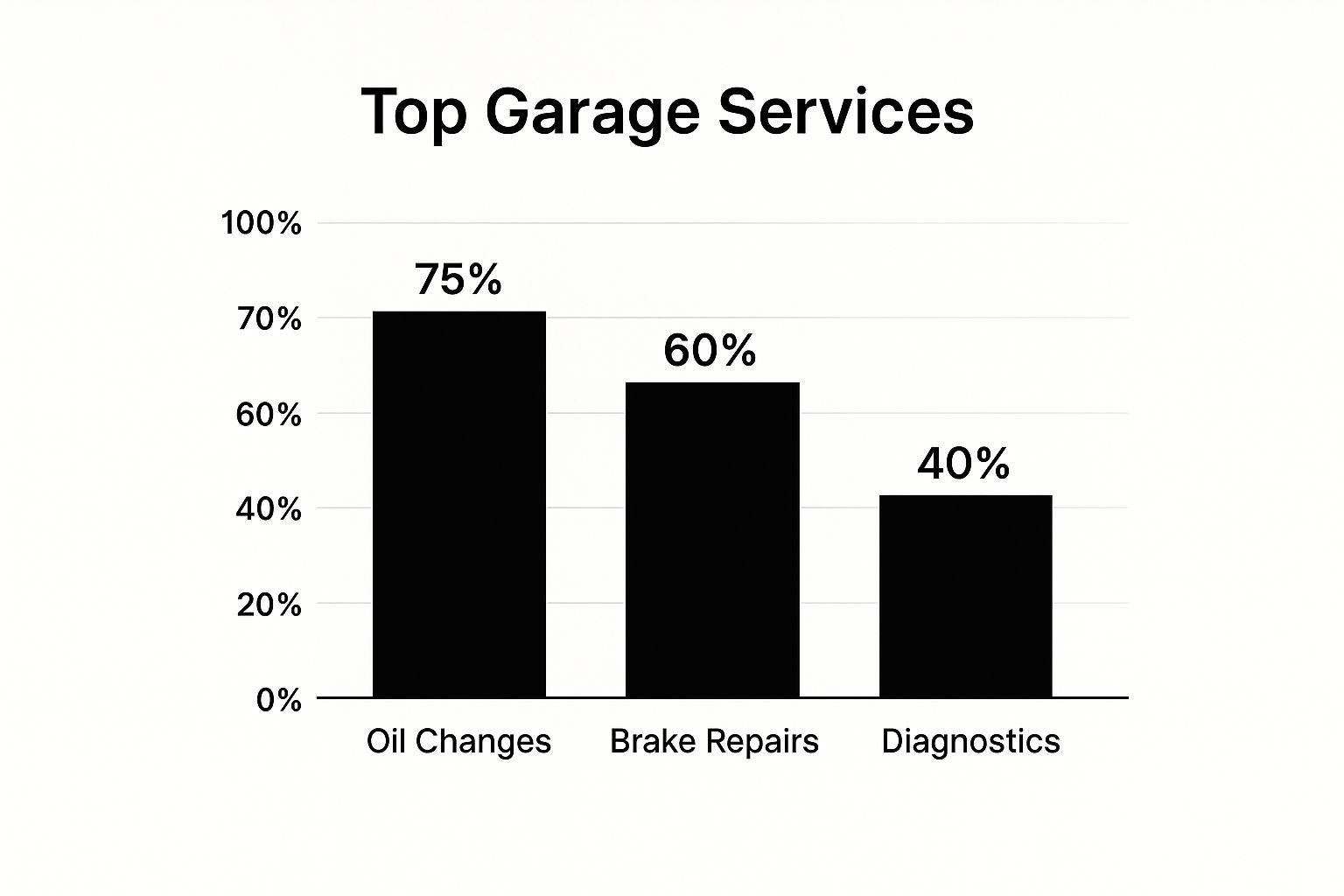
As you can see, the foundation of garage work includes things like oil changes and brake repairs. Sophisticated diagnostic work has become just as crucial for modern vehicles.
What Should a Top-Notch Garage Offer?
What separates a truly comprehensive workshop from a basic repair shop? The best garages offer a complete suite of services under one roof. This table breaks down the core offerings you should expect to see.
Core Offerings of a True Full Service Garage
Service Category | Typical Inclusions | Modern Additions for EV or Hybrid |
|---|---|---|
Routine Maintenance | Oil and filter changes, tyre rotation, fluid top-ups, full vehicle servicing. | Battery health diagnostics, coolant checks for thermal management systems. |
Brakes & Tyres | Brake pad and disc replacement, brake fluid change, tyre fitting and balancing. | Regenerative braking system checks and adjustments. |
Diagnostics | Engine management light (EML) fault finding, electrical system checks. | High-voltage battery diagnostics, charging port and cable inspection. |
Major Repairs | Engine and transmission work, clutch replacement, suspension repairs. | Electric motor and drivetrain repair, inverter and converter servicing. |
Specialist Services | MOT testing, air conditioning servicing, wheel alignment. | Advanced Driver-Assistance Systems (ADAS) sensor calibration. |
A garage that covers all these bases is well-equipped to be your go-to for the life of your vehicle, regardless of what issues arise.
Are They Ready for Modern and Future Cars?
The automotive world is evolving fast, and so are the demands on your local garage. The UK’s garage market is growing, not just because more people own cars, but because modern vehicles require consistent, expert upkeep. A key part of this shift is the rise of electric vehicles (EVs).
A forward-thinking garage must be skilled with more than just traditional petrol and diesel engines. When you’re vetting a potential workshop, ask if they have specific expertise in:
Hybrid Vehicle Systems: This means they can service both the internal combustion engine and the electric motor components.
EV Diagnostics and Repair: They should be able to handle battery health checks, charging system repairs, and issues with the electric drivetrain.
Advanced Driver-Assistance Systems (ADAS): After a repair (like a windscreen replacement), can they properly recalibrate the cameras and sensors your car relies on?
Finding a workshop that invests in new equipment and technician training is one of the strongest signals of quality. It shows they are serious about keeping up with the future of motoring and can properly support your car, no matter what powers it. This commitment is often what separates a basic repair shop from a true automotive partner.
Staying on top of your vehicle's health is more important than ever. You can learn more about this by reading our guide on why regular car service matters.
How to Assess a Garage's Reputation and Skill
Your car is one of your biggest investments, so you can't just hand the keys over to the first garage you find. Once you've moved past a basic "full service garage near me" search, it's time to do a little digging to confirm a workshop’s skills live up to its marketing.
A great starting point is to check what real customers are saying. While a garage's own website will likely be full of cherry-picked testimonials, you’ll get a far more realistic picture from independent sites like Google Reviews or Trustpilot. Look for recurring themes in the comments, both good and bad, as these often point to the truth of their day-to-day service.
Look for Official Accreditations
One of the clearest signs of a professional, trustworthy garage is its membership in established industry organisations. These aren't just fancy logos; they signal a genuine commitment to high standards and give you somewhere to turn if things go wrong.
Keep an eye out for affiliations with respected bodies like:
The Independent Garage Association (IGA): Being a member shows the garage follows a strict code of practice and is part of a trusted national network.
The Motor Ombudsman: This is your safety net. If a dispute pops up that you can't sort out directly, their impartial service is there to help resolve it.
A garage that invests in these memberships is showing you they stand behind their work and take customer service seriously.
Here's a pro tip: always ask about their specific experience with your car's make and model. A mechanic who sees Fords all day long will know their common quirks inside-out, often leading to a quicker, more accurate diagnosis than a generalist.
Confirming Technician Qualifications
Don't feel awkward asking about the team's qualifications. A garage with nothing to hide will be happy to tell you. Top-tier technicians often hold certifications from the Institute of the Motor Industry (IMI) or have completed training programmes directly with car manufacturers.
Seeing evidence of continuous training is a fantastic sign. It proves the mechanics are keeping their skills sharp and are up-to-date with the complex technology in modern vehicles. It’s what separates the real specialists from a standard repair shop.
Comparing Costs Without Sacrificing Quality

Let's talk about one of the biggest worries for any driver: getting a fair price for repairs without ending up with shoddy work. It’s a real balancing act. When you start getting quotes, the goal isn't just to find the lowest number. The cheapest option often ends up costing you more down the road. What you’re looking for is genuine value.
You'll often find that main dealer prices are quite a bit higher than those from a good independent garage. This isn't usually because the work is better, but because they have bigger overheads and brand-specific labour rates. An independent workshop can often deliver the same, if not better, quality for a more reasonable price.
Reading a Repair Quote Correctly
A proper quote should tell a complete story, not just give you a single figure. If a garage hands you a quote with just one total, do not hesitate to ask for a detailed breakdown. A trustworthy mechanic will have no problem explaining the costs.
Here’s what you should be looking for:
Parts Costs: Are the parts listed as Original Equipment Manufacturer (OEM) or aftermarket? OEM parts are the same ones fitted at the factory. High-quality aftermarket parts are made by other companies and can be just as good—sometimes even better—and more affordable. A reputable garage will be transparent about which they use and why.
Labour Rate: This is what the garage charges per hour for their mechanic's time. You should always ask what their hourly rate is and how long they expect the job to take. It’s a basic sign of transparency.
VAT: Always double-check that VAT is included in the final price. A quote that seems suspiciously low might just be missing the 20% tax, which can be a nasty surprise later on.
A detailed, transparent quote is a sign of an honest garage. It shows they're confident in their pricing and have nothing to hide. If a workshop seems reluctant to break down the costs for you, consider it a major red flag.
Getting to grips with these figures is the only way to compare different garages on a level playing field. For more insights on keeping your car running without breaking the bank, take a look at our guide on cost-effective car repairs, which is packed with smart tips for every driver.
The Real Cost of Skipping Regular Car Service
It’s tempting, isn’t it? Your car seems to be running just fine, life is hectic, and that service reminder just feels like another task you can push down the to-do list. If you've ever thought this, you're not alone. Many drivers put off maintenance, hoping to save a bit of time and money in the short term.
This isn't just a hunch; the numbers back it up. A recent survey from Direct Line Group on driver service habits revealed that around 1.3 million UK motorists are currently on the road with an out-of-date service. What's more, 5% don't even know when their next service is due. The top reason? A quarter of those who skipped simply said their car "felt fine".
But as any experienced mechanic will tell you, this "if it ain't broke, don't fix it" mindset can backfire, often spectacularly.
From Minor Tweak to Major Meltdown
Ignoring a routine service can quickly snowball a small, inexpensive fix into a massive repair bill.
Think about your brake pads. During a service, a technician would spot they're getting low—a simple, relatively cheap replacement. Put it off, and you could end up grinding away at the brake discs and calipers. Suddenly, that minor job has turned into a repair costing hundreds of pounds more.
Or consider a classic, real-world nightmare: the timing belt. It’s a crucial part that gets checked during a full service. If that belt snaps while you’re driving, it can cause catastrophic engine damage. We're talking about a repair that can easily run into thousands, often costing more than the car is even worth.
A scheduled service isn't just another bill. It's an investment in your car's health and your own peace of mind. It’s about catching these potential disasters while they’re still small, manageable problems.
Protecting Your Car's Value and Your Wallet
Beyond just preventing breakdowns, regular servicing pays you back in a couple of very tangible ways:
Better Resale Value: A full service history is gold dust when you decide to sell. Any smart buyer will ask for it, as it’s proof the car has been looked after properly. This alone can add hundreds to your car's value.
Improved Fuel Efficiency: An engine running on fresh oil, with clean filters and correctly inflated tyres, is a happy and efficient engine. It doesn't have to work as hard, which means it uses less fuel. You’ll genuinely notice the difference at the petrol station.
Knowing the right service schedule for your vehicle is the first step. For a complete breakdown, have a read of our guide on how often to service a car in the UK.
Don't Underestimate Location and Convenience

When you type "garage near me" into a search bar, you're looking for more than just a pin on a map. True convenience is about how easily the garage fits into your life. Is it closer to home, or is it near your office? Figuring that out can be the difference between a minor inconvenience and a major headache when it's time to drop off and pick up your vehicle.
The UK's motor vehicle maintenance industry is a massive £34.9 billion sector, but the garages aren't spread out evenly. You'll find the highest concentration in the South of England, particularly the South East and South West. This makes sense, as higher car ownership in these areas fuels the demand. You can dig deeper into these trends with IBISWorld's report on UK motor vehicle repair.
What Does Real Convenience Mean?
Being nearby is one thing, but the best garages go the extra mile to minimise the disruption to your day. It’s these thoughtful touches that really count, especially when you're facing a more complex, time-consuming repair.
Keep an eye out for these game-changing services:
Courtesy Cars: A lifesaver. Being able to borrow a set of wheels means your life doesn't grind to a halt just because your car has.
Collection & Delivery Service: Some of the best garages will collect your car from your home or work and bring it back once the job is done. It doesn't get much easier than that.
A Decent Waiting Area: If you do have to wait, a clean waiting room with a good cup of coffee and reliable Wi-Fi makes all the difference.
A garage’s location matters, but its attitude towards customer convenience is what separates the good from the great. When a garage offers these kinds of services, it shows they respect your time and are committed to making the entire process as painless as possible.
It's these practical considerations that are key to finding a local car service you can trust, so make sure you weigh them up alongside everything else.
It’s natural to have questions when you're trying to find the right people to look after your car. After all, you want to be sure you're making the best choice. Let's tackle some of the most common queries we hear from drivers.
Will Using an Independent Garage Void My Car's Warranty?
This is a big one, and thankfully, the answer is no. Thanks to something called 'Block Exemption' regulations in the UK, you have the freedom to take your car to any independent garage for servicing without invalidating its manufacturer warranty.
There's just one crucial condition: the garage must use parts that are either genuine manufacturer-approved or of equivalent quality. They also have to follow the manufacturer's service schedule to the letter. Don't be shy about asking for confirmation of this, and make sure they stamp your service book or update the digital record.
What’s the Real Difference Between an Interim and a Full Service?
Think of an interim service as a six-month health check, usually done every 6,000 miles. It’s designed to catch any developing issues between your main annual services and typically includes an oil and filter change, a top-up of all fluids, and a check of key safety points like tyres and lights.
A full service, on the other hand, is the comprehensive annual appointment, recommended every 12,000 miles. It’s a much deeper dive, covering everything from the interim service plus a whole lot more. This often involves replacing air and fuel filters, new spark plugs, and detailed inspections of the engine, brakes, and suspension systems.
A quick tip: if you're ever not happy with work a garage has done, the best first step is always a calm chat with the manager. A good garage wants to put things right. If you can't get a resolution, see if they're a member of The Motor Ombudsman—they provide a free service to help settle disputes.
For transparent advice and expert care covering everything from MOTs to complex diagnostics, trust the team at Krause Autos. Visit us online at https://www.krauseautos.co.uk to book your next service.


Comments