


When to Replace Car Tyres: A UK Guide
Knowing when to replace your tyres is straightforward once you know what to look for. You will need new tyres if the tread depth drops below 1.6mm, they are more than 10 years old, or if you spot any obvious damage like cracks or bulges. Keeping an eye on these three areas is the best way to keep your car safe and legal on UK roads.
Your Guide to UK Tyre Replacement
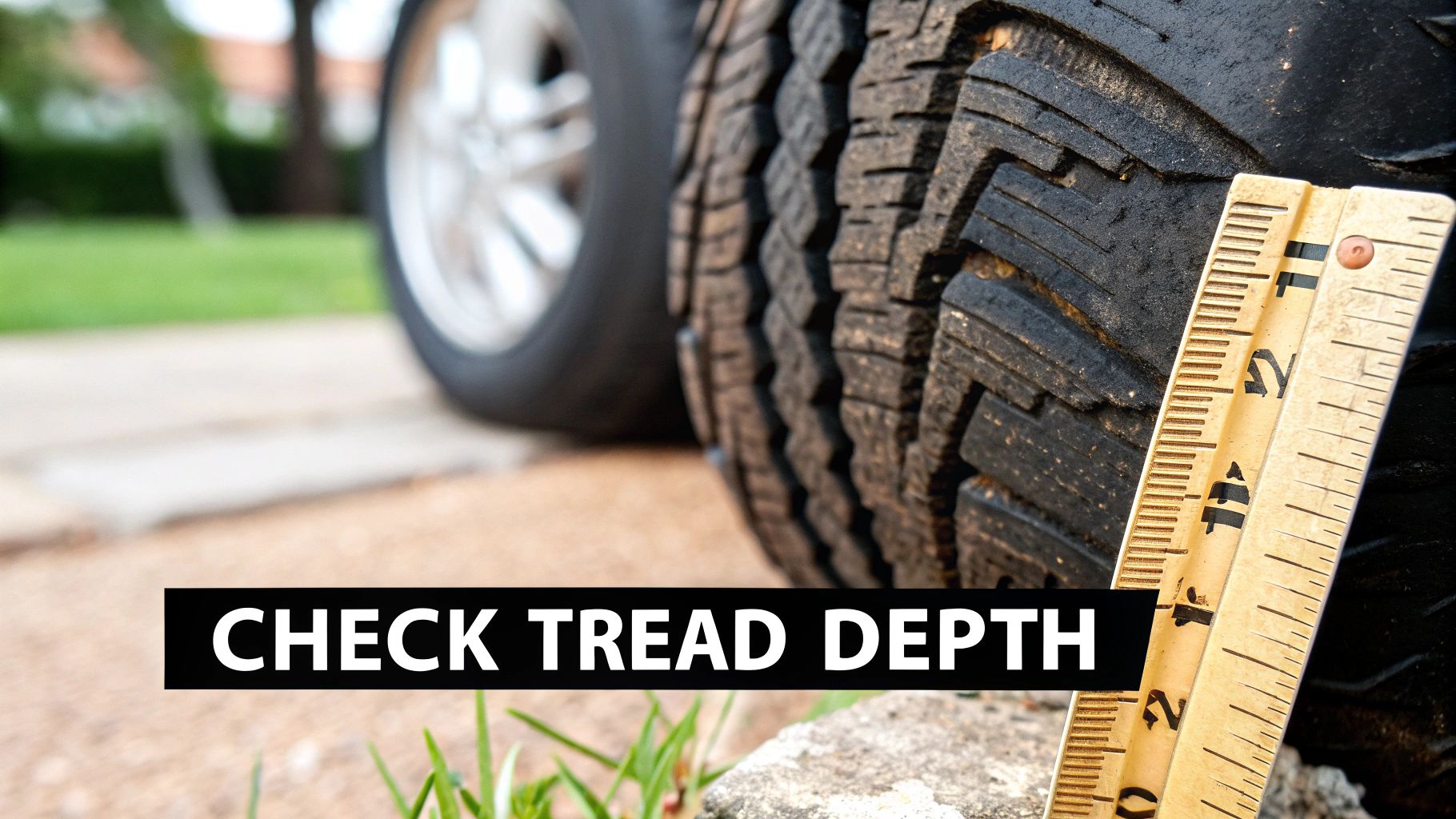
It’s easy to forget, but your car's entire connection to the road comes down to four small patches of rubber. That’s it. Understanding when to replace your tyres isn't just another box-ticking exercise in vehicle maintenance; it directly affects your safety, how your car handles, and its fuel efficiency. Ignoring them is a genuine risk that could land you with hefty fines and penalty points on your licence.
This isn't a rare problem. A nationwide survey organised by TyreSafe revealed a startling statistic: out of more than 340,000 tyres they checked at the point of replacement, a shocking 27.3% were already illegal. The main culprit was tread depth worn down below the legal limit. You can dig into the findings yourself by reviewing the tyre safety infographic research on Tyresafe.org.
The Three Pillars of Tyre Health
How do you make the right call? It all boils down to checking three key things. This guide will walk you through each one, so you know exactly what to look for and can feel confident in your decision.
The main signs that your tyres are due for a change are:
Tread Depth: Those grooves aren’t just for show; they are needed for channelling water away from the tyre. As they wear down, your car's grip on wet roads plummets, dramatically increasing your stopping distance.
Age: Time takes its toll on everything, and rubber is no exception. A tyre can look perfectly fine on the outside but become brittle and weak over the years, making it unsafe.
Visible Damage: This is the most obvious red flag. Any bulges, deep cuts, or cracks are clear warnings that the tyre’s internal structure has been compromised. A failure could be just around the corner.
Your tyres are one of the most critical safety features on your vehicle. A simple check that takes less than five minutes a month can spot a developing issue long before it puts you and others in danger.
In the rest of this guide, we'll give you clear steps for checking each of these areas. By learning to spot the warning signs early, you can keep yourself safe, stay on the right side of the law, and help your car perform exactly as it should.
Tyre Replacement Quick Reference Guide
To make things even easier, here’s a quick summary of the key indicators that tell you it’s time for new tyres. This table covers both the legal requirements and what we recommend for optimal safety.
Indicator | Legal Minimum (UK) | Safety Recommendation | What to Look For |
|---|---|---|---|
Tread Depth | 1.6mm across the central 75% | Replace at 3mm | Uneven wear, shallow grooves, tread wear bars showing |
Tyre Age | No legal age limit | Replace after 10 years | 4-digit date code on the sidewall (e.g., 3221) |
Damage | No significant cuts/bulges | Replace immediately | Cracks, bulges, exposed cords, deep cuts, punctures |
Remember, these are your primary checks. If you're ever in doubt, the best course of action is always to get a professional opinion from a trusted garage.
How to Read the Signs of Tyre Wear
Your tyre's tread is the only thing keeping your car connected to the road, especially when it's wet and slippery. As that tread wears down, so does your car’s ability to grip. That’s why keeping a close eye on your tread depth is a crucial part of knowing when to replace your tyres.
The good news is you don’t need to be a mechanic or have fancy tools to get a quick read on your tyre's health. The classic '20p test' is a brilliant, simple check anyone can do in a minute. Just take a 20p coin and pop it into the main tread grooves of your tyre.
Can't see the outer band of the coin? Great, your tread is likely well within the legal limit. If you can see that outer band, it’s a clear sign your tread is getting low and it's time to have it looked at by a professional. Making this a monthly habit is one of the smartest things you can do for your car's safety.
Interpreting Tread Wear Indicators
On top of manual checks, your tyres come with their own built-in safety net: the tread wear indicators (TWIs). These are small, raised bars tucked away in the bottom of the main grooves. To find them, look for a little 'TWI' marking (or sometimes a triangle symbol) on the sidewall of the tyre – it'll point you right to them.
When your tyre is fresh out of the factory, you’ll barely notice these bars. But as your tread gradually wears away, they become more obvious.
Once the surface of your tread is flush with these indicator bars, your tyre has hit the UK legal minimum tread depth of 1.6mm. This isn't just a warning; it means the tyre is no longer road-legal and must be replaced immediately.
Understanding Uneven Tyre Wear
It’s not just about how much your tyres have worn down, but how they've worn. Ideally, you want to see the tread wearing down evenly right across the surface. More often than not, you'll spot specific wear patterns that act as clues, pointing to underlying issues with your car.
This image below is a fantastic guide to what you should be looking for.
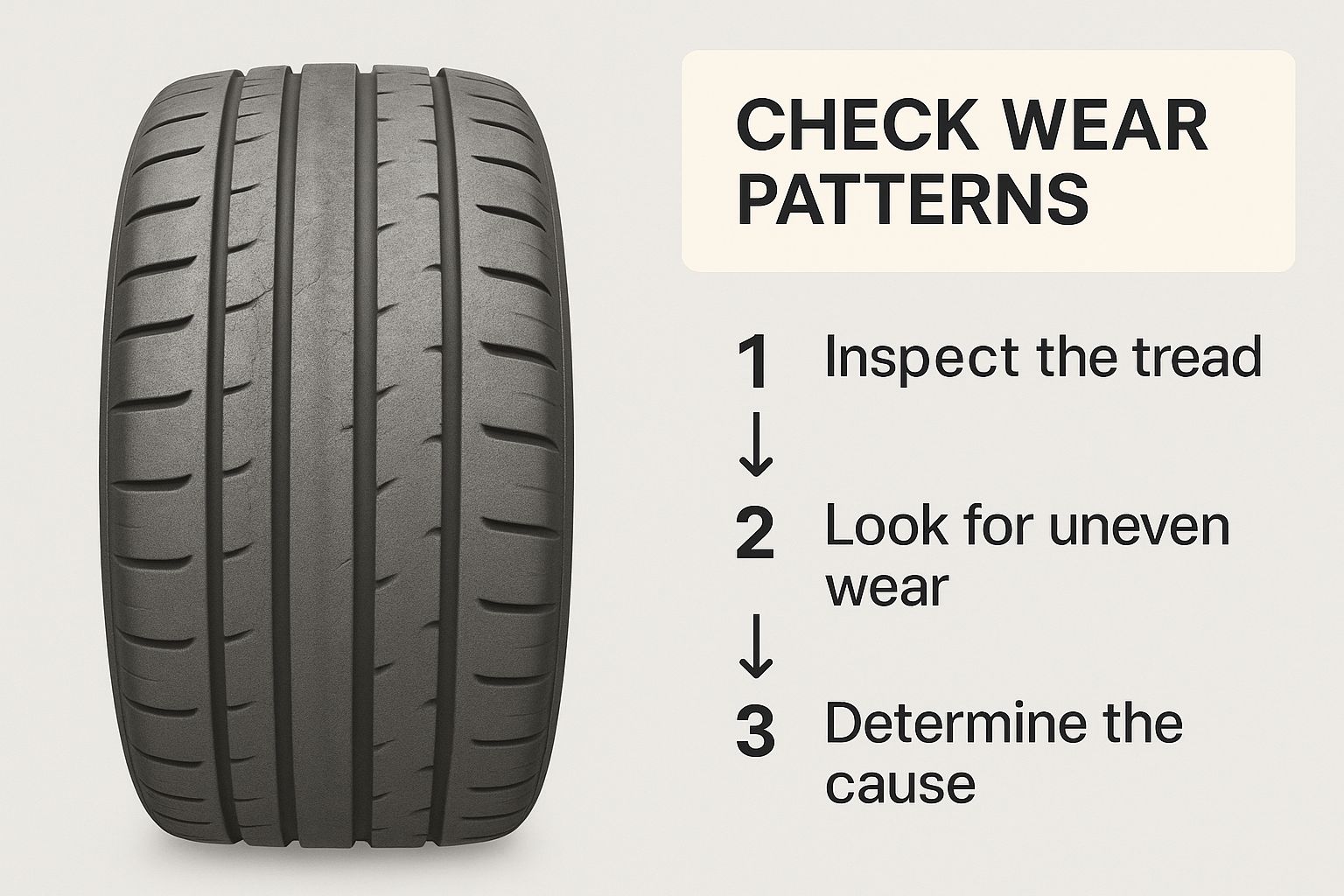
As you can see, a proper inspection goes beyond just checking the depth. You need to look at the entire surface to get the full story of your car's health.
Catching these patterns early can save you money and a lot of hassle down the line. We explain this in more detail in our guide on the top car tyre replacement signs every driver should know.
Here are a few of the most common culprits you might find:
Centre Wear: If the very middle of your tyre is wearing out faster than the edges, it’s a classic sign of over-inflation. Too much air pressure makes the centre of the tread bulge out, forcing it to do all the work.
Edge Wear: See both outer edges (or shoulders) wearing down quicker than the middle? This is almost always caused by under-inflation. With too little air, the tyre sags and puts all the pressure on those edges.
Cupping or Scalloping: This pattern looks like diagonal or scooped-out patches across the tread. It’s a tell-tale sign of a problem with your suspension or wheel balancing.
You must address the root cause of these wear patterns. Whether that means adjusting your tyre pressure or booking in for a wheel alignment, you have to fix the underlying fault. If you don't, you're just throwing money away, as the brand-new tyre you fit will wear out in exactly the same premature way. A little proactive inspection goes a long way to making you a safer, smarter car owner.
It's Not Just About Tread: The Hidden Dangers of Tyre Age
You can have a tyre that looks like it has miles of life left in it, but it could still be a ticking time bomb. While we're often focused on tread depth—something you can easily see and measure—the invisible enemy is the tyre's age. The rubber compounds in your tyres don't last forever. They're constantly exposed to the elements, from UV light and summer heat to the very air we breathe, and this causes them to break down through a process called oxidisation.
This gradual decay is what makes an old tyre so risky. The rubber loses its flexibility and becomes brittle. On the outside, it might look fine, but internally, its structure could be seriously compromised. This weakness dramatically increases the risk of a sudden, catastrophic failure, particularly when you’re driving at speed on a motorway. Checking your tyre's age is just as critical as checking its tread.
How to Find Your Tyre's "Birth Date"
How do you tell how old your tyres are? You need to play detective and look for the DOT code stamped right onto the sidewall. It’s a string of letters and numbers, but you only need to worry about the last four digits.
These final four numbers tell you the week and year the tyre was made. For instance, if you see the numbers '2522', it means that tyre rolled off the production line in the 25th week of 2022. A quick check of this code on each tyre gives you its exact age.
Don't forget the spare! That tyre sitting in the boot, seemingly protected from the elements, is still ageing. Time degrades the rubber whether it's on the road or not. An old spare might get you to the nearest garage in an emergency, but you shouldn't rely on it for anything more.
When Age Trumps Tread
When does a tyre become too old, regardless of its condition? The widely accepted rule in the industry is that any tyre hitting ten years of age should be replaced, no questions asked. Many car manufacturers and safety bodies suggest you should start thinking about replacement from as early as six years. The rubber just becomes too unpredictable to trust after that point.
This is something to be especially wary of when buying a used car. A vehicle might have a fresh MOT certificate, but if it’s running on old, hardened tyres, you could be in for an immediate and expensive trip to the tyre fitters. Always make checking the DOT codes part of your pre-purchase inspection.
With people keeping their cars for longer—data shows nearly 52% of UK drivers are in cars over five years old—this is a growing concern. It means more of us are driving on tyres that might be legal on tread depth but are well past their safe-by date, which can have a real impact on everything from braking distances to cornering grip. As Tyrepress.com highlights in its analysis of ownership trends, when it comes to tyre safety, age really is more than just a number.
How to Spot Tyre Damage Before It Is Too Late
While checking tread depth and tyre age are routine tasks, spotting physical damage is an entirely different ball game. Damage is an immediate red flag that demands instant attention. A sudden tyre failure on the motorway can be catastrophic, which is why making regular visual inspections a habit is your best defence against a disaster.
A quick walk around your car before you set off is often all it takes. You're simply looking for anything on the tyre's surface that just doesn't look right, paying special attention to the sidewalls. The sidewalls aren't nearly as tough as the main tread, so any damage there is far more serious.
What to Look For During a Visual Check
Try to get into the habit of giving your tyres a once-over every couple of weeks and always before a long trip. It takes seconds. You're looking for tell-tale signs of distress that show a tyre's structural integrity might be on its last legs.
Here are the main culprits I always tell people to watch out for:
Cracks and Cuts: Tiny, web-like cracks on the sidewall might look harmless, but they're a dead giveaway that the rubber is drying out and getting brittle. Deeper cuts are an even bigger worry, as they can hide serious damage to the tyre's internal structure.
Bulges or Blisters: This is the one you really don't want to see. A bulge is a noticeable lump pushing out from the sidewall, and it’s a critical warning sign. It means the internal framework of the tyre has failed, usually after a nasty encounter with a pothole or kerb. A tyre with a bulge needs replacing. Period.
Punctures and Embedded Objects: You might spot a nail or screw head stubbornly stuck in your tread. Often, these cause a slow puncture that you might not notice for days. If you see something embedded, resist the urge to pull it out! That is often what’s stopping all the air from rushing out. Just drive slowly and carefully to a garage to have it looked at by a professional.
A bulge on the sidewall is one of the most dangerous types of tyre damage. Think of it like a weak spot on a balloon—it's stretched thin and under immense pressure. It's not a matter of if it will fail, but when, and you don't want that to be at 70 mph.
The Big Question: Repair or Replace?
You've spotted some damage. The next logical question is whether it can be safely repaired or if the tyre is a write-off. The answer almost always comes down to two things: the type of damage and its location. A simple puncture from a nail in the right place can often be repaired, but only if it meets very specific safety standards.
To help you make the right call, you need to know what's safe and what isn't. You can find more detailed information in our article on how to check your tyre tread, which is the perfect partner to these visual damage checks.
I've put together this quick table to help you assess common scenarios and decide what to do next.
Tyre Damage Assessment: Repair or Replace?
Type of Damage | Location | Recommended Action | Safety Risk Level |
|---|---|---|---|
Small Puncture (e.g., nail) | Central 75% of the tread | Repair (if under 6mm) | Low to Medium |
Bulge or Blister | Sidewall or shoulder | Replace Immediately | High |
Large Cut or Gash | Anywhere | Replace Immediately | High |
Puncture or Cut | Sidewall or shoulder | Replace Immediately | High |
Exposed Cords | Anywhere | Replace Immediately | High |
The bottom line is that a puncture right in the main, central part of the tread is often repairable. But any damage at all to the sidewall or the tyre's "shoulder" area means it's game over for that tyre. The sidewall has to flex constantly as you drive, and a repair plug simply won't hold safely under that stress.
When in doubt, always trust a professional. It's just not worth the risk.
How Your Driving and the British Weather Affect Your Tyres
It’s easy to think that knowing when to replace your tyres is all about tread depth and age. While those are factors, the real story is often written by the way you drive every day. Your personal driving style, the roads you tackle, and the famously unpredictable UK weather all play a massive part in how long your tyres last.
Aggressive driving is like fast-forwarding your tyre’s lifespan. Flooring it from the traffic lights, slamming on the brakes, and taking corners like you’re on a track all generate immense heat and friction. This absolutely shreds your tread, meaning you'll be looking at a replacement bill far sooner than someone with a smoother, more considered driving style.
The same goes for the roads you use. If your daily commute involves navigating country lanes plagued by potholes, you’re putting a huge amount of stress on the tyre's internal structure. Consistently carrying heavy loads also adds to the strain, forcing the rubber to work harder and wear down quicker.
Picking Tyres Suited to the UK Climate
Here in the UK, we can get all four seasons in a single week. This makes choosing the right type of tyre a critical decision for your safety and your wallet. Get it right, and you'll have a safer drive and a more predictable replacement schedule.
Your choices generally boil down to three main types:
Summer Tyres: These are built with a harder rubber compound that gives fantastic grip and handling when the weather is mild (above 7°C). They are not designed for cold, icy, or snowy conditions.
Winter Tyres: Made from a much softer rubber, these have deep, complex tread patterns that excel at gripping the road and stopping safely when the temperature drops below 7°C.
All-Season Tyres: A smart hybrid solution, designed to offer a great balance of performance across both summer and winter conditions. For the moderate but ever-changing UK climate, they’re often a brilliant year-round option.
Whether you should swap tyres seasonally or stick with all-seasons really comes down to where you live, how many miles you cover, and your specific driving needs. Swapping twice a year is an extra task but guarantees peak performance. All-season tyres offer fantastic convenience and are rapidly gaining favour.
This isn't just a feeling; the market data backs it up. There's been a clear trend towards all-season tyres in the UK, simply because they are so well-suited to our climate's personality. This shift is changing how and when people replace their tyres, with many choosing one set for year-round peace of mind.
Making the Smart Choice for Your Car
Your decision here directly impacts your replacement timeline. If you opt to swap between summer and winter sets, each set will last for more years, but you have the initial cost of buying eight tyres instead of four. Sticking with a single set of all-seasons means they’ll wear out sooner in terms of time, but you skip the cost and hassle of seasonal changes.
Getting a feel for how your daily drive and our climate affect your rubber is what it's all about. By matching your tyre choice to your actual habits, you'll make a decision that's safer, smarter, and more cost-effective in the long run.
For a deeper look into this, have a look at our comprehensive guide on choosing the right tyres in 2025.
Common Questions About Replacing Car Tyres
When it's time to get new tyres, a few practical questions always come up. Getting clear answers helps you make smart, cost-effective choices that keep your car safe and handling just as it should. Let's tackle some of the most common things drivers ask us.
One of the biggest dilemmas is whether to replace tyres in pairs or spring for a full set of four. In a perfect world, replacing all four at once is the gold standard. It gives you perfectly balanced grip, predictable handling, and peace of mind. For all-wheel-drive (AWD) cars, this is especially beneficial, as mismatched tread depths can put a real strain on the vehicle's drivetrain.
Can I Just Replace Two Tyres?
For most front-wheel or rear-wheel drive cars, yes, replacing just two tyres is often a perfectly safe and sensible option.
If you decide to go this route, here’s a crucial piece of advice we always give: always fit the newest tyres to the rear axle. I know it sounds a bit backwards, especially on a front-wheel-drive car, but there's a good reason. The rear wheels are what stabilise your car, and putting fresh rubber with deep tread back there massively improves stability and helps prevent a dangerous oversteer skid, particularly in the wet.
The new pair should be a proper match for the existing ones in size, speed rating, and type. You definitely don't want to be mixing summer and winter tyres, for instance – that is just asking for unpredictable handling.
A question we often hear is about replacing a single tyre after a puncture. This is really only a good idea if the other tyre on that same axle is nearly new itself, with very little tread wear. A noticeable difference in tread depth across an axle can seriously compromise your car's braking and stability.
What Should I Expect to Pay?
Tyre prices here in the UK can be all over the map, depending on what your car needs. For a small city runaround, a budget tyre might set you back £50–£70 per corner. For a performance SUV or a sports car, a premium high-performance tyre could easily be £150–£250 or even more.
The main things that affect the price are:
The Brand: Premium names like Michelin or Pirelli will always command a higher price than mid-range or budget options.
Tyre Size: It's simple really – bigger tyres for larger wheels cost more to make and more to buy.
The Type: Specialised tyres, like run-flats or ultra-high-performance models, come with a premium price tag.
Any quote you get should always include the full works: fitting, a new valve, wheel balancing, and the responsible disposal of your old tyre. Remember, keeping your vehicle in top shape is about more than just the rubber. Regular maintenance is a key part of car care. For more on that, take a look at our guide on how often to service a car for UK drivers. A total approach to car care helps every component work in harmony.
For honest, expert advice on when to replace your car tyres, or for any other servicing and repair needs in Bedfordshire, you can always trust the team at Krause Autos. We give transparent recommendations and professional fitting services to keep you moving safely. Visit us at https://www.krauseautos.co.uk to book an appointment.


Comments