


What Are Bosch Vehicle Diagnostics and Why Do They Matter?
Imagine if your car could sit down with a technician and tell them, word for word, exactly what was ailing it. In a way, that's what a Bosch vehicle diagnostic system does. It acts as a highly skilled translator, turning your car’s complex computer language into clear, usable information for a mechanic.
Understanding Bosch Vehicle Diagnostics
Modern cars are packed with small, powerful computers called Electronic Control Units, or ECUs. Think of them as the car's digital nervous system. They manage everything from the engine's fuel-to-air ratio and performance right through to your anti-lock brakes and airbag deployment systems.
When a part isn't behaving, the relevant ECU logs a specific fault code. Bosch diagnostic equipment plugs directly into your vehicle's central computer to read these codes. It then presents that data in a format a trained technician can immediately understand, giving them a detailed, non-invasive health report of your car's inner workings.
A Deeper Look at the Technology
The best way to think about it is like a medical scan for your car. Instead of a doctor analysing an MRI, a technician is reviewing a detailed data map from all the vehicle's ECUs. This lets them pinpoint the root cause of a problem, not just the symptom you might be noticing from the driver's seat. For the complex cars we drive on UK roads, this level of precision is needed for an accurate and efficient repair.
If you're curious to learn more, we cover the fundamentals in our essential guide for every driver on vehicle diagnostic basics.
This technology goes far beyond simply reading historical fault codes. It allows technicians to interpret live data streams from sensors all over the vehicle. This gives us a complete, real-time picture of what’s happening under the bonnet and throughout the car’s systems.
To give you a clearer idea, here's a breakdown of what a comprehensive Bosch scan typically covers.
Core Functions of a Bosch Diagnostic Scan
System Checked | Typical Information Gathered |
|---|---|
Engine Management | Misfire detection, fuel injector timing, oxygen sensor readings, air flow data. |
Transmission System | Gear shift patterns, fluid pressure and temperature, torque converter function. |
Safety Systems | Status checks for ABS, airbags, traction control, and stability control sensors. |
Emissions Control | O2 sensor performance, catalytic converter efficiency, exhaust gas recirculation (EGR) values. |
A Bosch scan provides a complete view, making sure that even minor electronic faults don't go unnoticed before they can become major mechanical problems.
Bosch's influence in this field is massive. As a key player, the company commands over 10% of the global market share for automotive fault diagnostic tools. Its presence in the UK is particularly strong, built on decades of automotive expertise that aligns perfectly with our large vehicle market and stringent emissions standards. By continuously developing tools that offer real-time data analysis for petrol, diesel, and the growing fleet of electric and hybrid vehicles, Bosch supports workshops like ours to have the right technology to service any car that comes through the door.
A Look Inside the Diagnostic Process
So, a warning light has popped up on your dash, or maybe your car just feels… off. What actually goes on during a diagnostic check? It’s not about guesswork; it's a structured conversation between a trained mechanic and your car's brain, with advanced equipment acting as the universal translator.
The process kicks off when we plug a specialised scanner, like a Bosch KTS series tool, into your car. This connects via the On-Board Diagnostics (OBD-II) port, a standard socket you’ll find in virtually every car built since the late 1990s. You can think of it as the main communication hub for your vehicle's entire network of computers.
The Initial Connection and System Scan
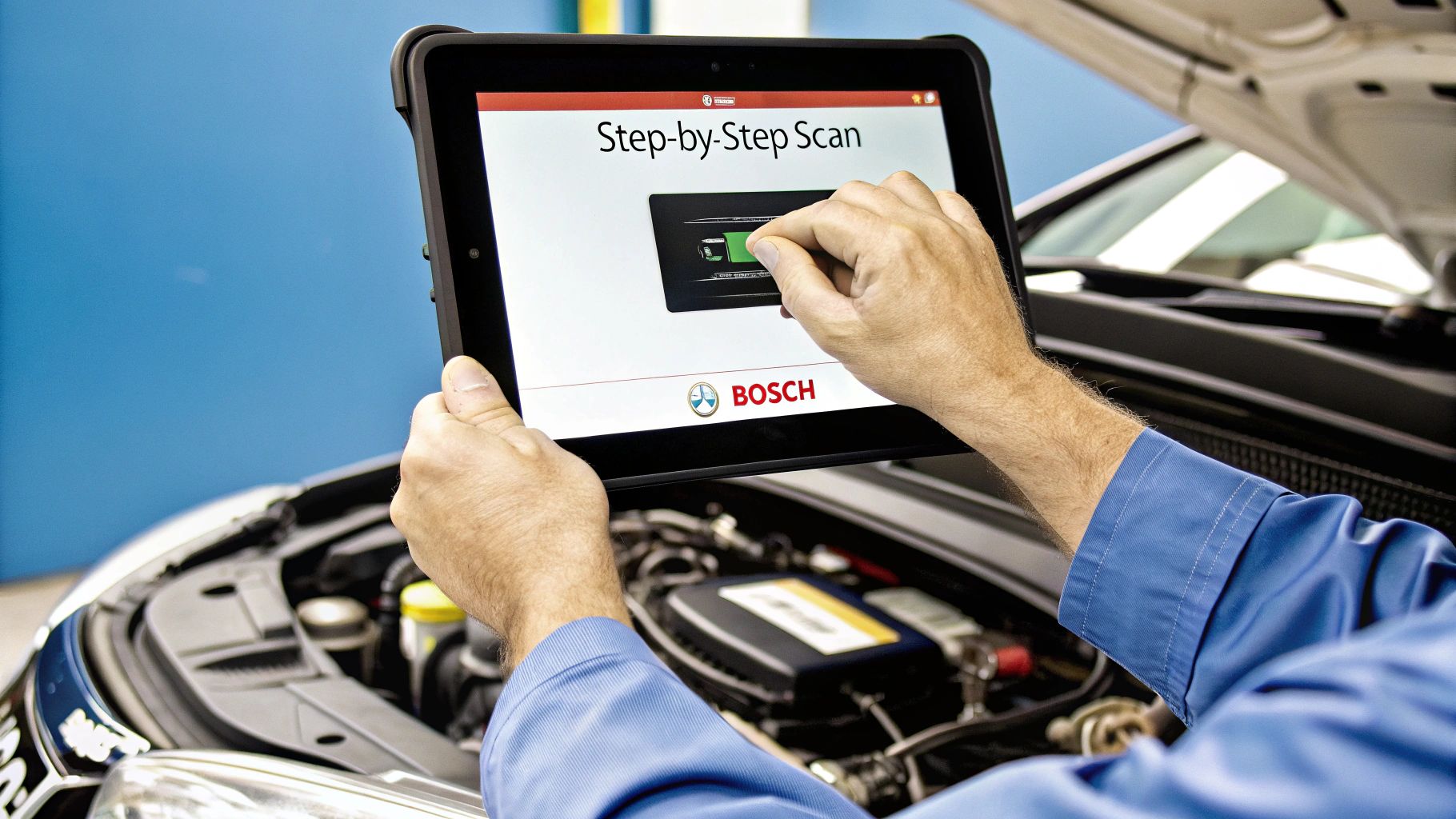
With the tool physically connected, the technician fires up the diagnostic software – in our case, Bosch’s powerful ESI[tronic] platform. The software then sends out a "hello" signal to every single Electronic Control Unit (ECU) in the car, from the engine management to the ABS and airbag systems. This starts a comprehensive scan, pulling in two streams of information to build a complete picture of your vehicle's health.
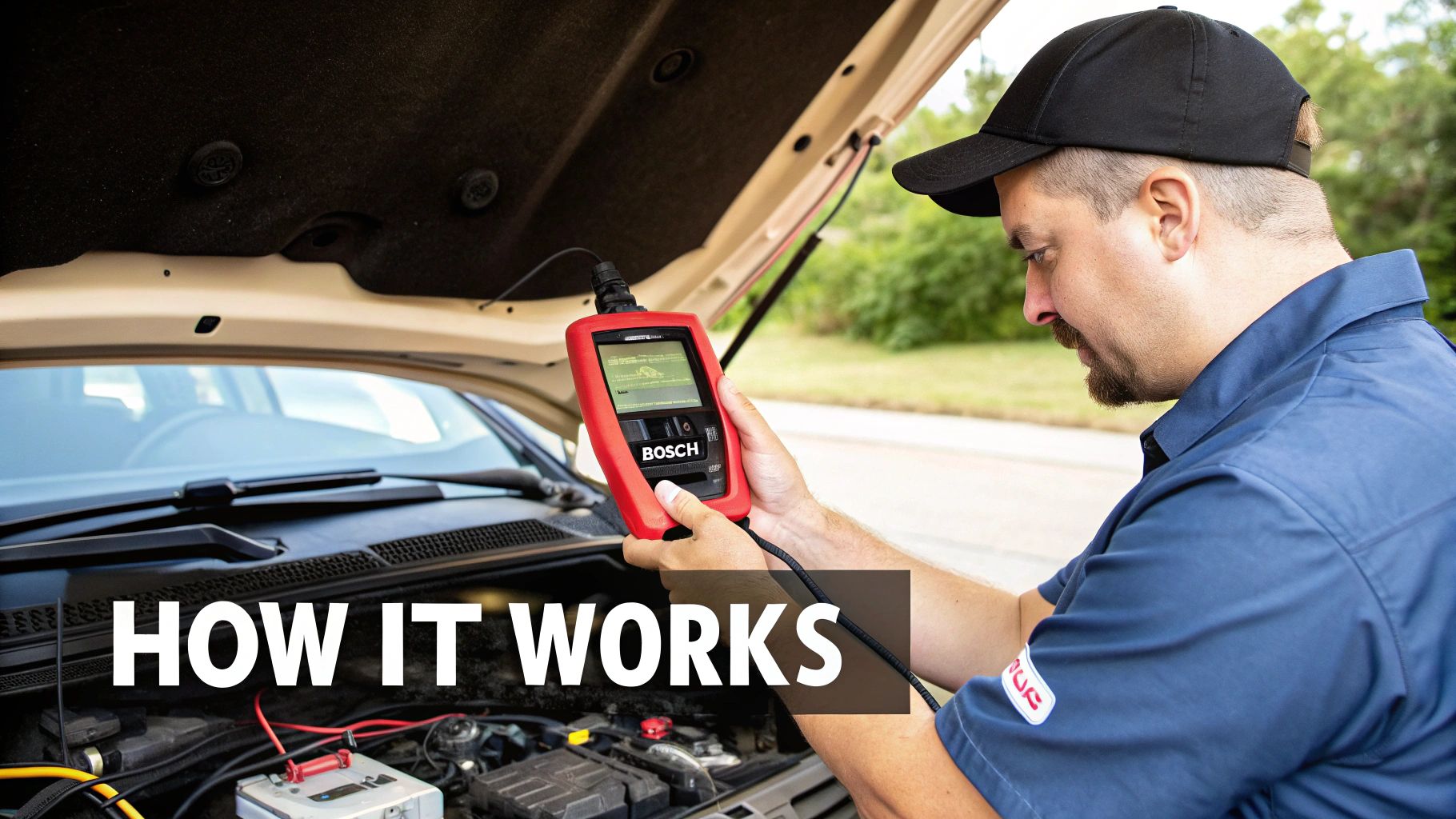
The image below shows one of the modern Bosch KTS diagnostic tools we use. It’s the physical link between our expertise and your car's complex computer systems.
This bit of kit is what allows us to talk directly to everything from your engine to your safety features, getting straight to the source of any issues.
Gathering Fault Codes and Live Data
During the scan, the tool gathers two distinct types of information. Each one tells a different part of the story, and together, they are critical for an accurate diagnosis.
Stored Fault Codes: When one of your car’s computers detects a problem—say, a sensor reading is way off or a cylinder isn't firing correctly—it logs a Diagnostic Trouble Code (DTC). These codes point us directly to the system, and often the specific circuit, that’s acting up.
Live Data Streams: This is a real-time feed from all the sensors around your vehicle. We can see everything from engine RPM and vehicle speed to coolant temperature and oxygen sensor readings as they happen. Watching this data live shows us how the car is performing at that very moment.
A common misconception is that a fault code is the diagnosis. It isn't. Think of it more as a very precise signpost pointing us in the right direction. It tells us where to look, but it's the combination of the code, the live data, and the technician's experience that reveals the why.
This methodical approach is the foundation of efficient Bosch vehicle diagnostics. It allows a skilled mechanic to move from a vague symptom to a precise cause without wasting time or your money on guesswork.
For UK drivers keen to learn more, our 2025 car diagnostic check guide provides even greater detail. It’s this final step—where technology meets human expertise—that transforms raw data into a successful repair, getting you back on the road safely and efficiently.
Real-World Benefits for Your Vehicle
So, what does all this complex technology actually mean for you and your car? The most immediate advantage of a Bosch vehicle diagnostics check is its incredible accuracy. Plain and simple, it takes the guesswork out of car repairs.
Forget the old, time-consuming approach where a mechanic might swap out parts hoping to stumble upon the fault. This technology points us directly to the source of the problem. It saves you valuable time and, crucially, stops you from paying for parts your car never even needed. It's the difference between wandering around in the dark and having a spotlight shining right on the issue.
This direct approach naturally leads to faster repairs and lower labour bills, because our technicians can get straight to work on the right component without any trial and error.
Preventative Care and Long-Term Health
Another huge benefit is the ability to catch problems while they’re still small—long before they escalate into serious, and often expensive, mechanical failures. A deep diagnostic scan can pick up on tiny irregularities that are impossible to notice from behind the wheel.
These early warnings allow us to perform proactive maintenance instead of waiting for a breakdown. By catching a small sensor fault or a minor system error early, you can prevent a domino effect that could lead to much bigger trouble down the road.
This preventative mindset doesn't just improve your car's reliability day-to-day; it also plays a massive role in protecting its long-term resale value. A vehicle with a clean bill of electronic health is always a better investment.
Safety and MOT Compliance
Modern cars rely on a whole network of computers to manage their safety features. A proper diagnostic scan gives us—and you—the peace of mind that these critical systems are working exactly as they should be.
We can verify the health of key safety systems, including:
Airbag Systems: Confirming every sensor and deployment circuit is armed and ready.
Anti-lock Braking Systems (ABS): Checking that the wheel speed sensors and hydraulic controls are responding instantly.
Traction and Stability Control: Making sure the systems that keep you from skidding are fully operational.
For drivers here in the UK, there's another very practical benefit when it comes to the annual MOT test. A Bosch vehicle diagnostics check confirms your car's emissions systems are running cleanly and within legal limits. This means you can head to your MOT with confidence, knowing a major potential failure point has already been given the all-clear.
Diagnosing Modern Electric and Hybrid Vehicles
As more of us in the UK get behind the wheel of electric and hybrid cars, the world of vehicle maintenance has had to evolve, and fast. These cars might be missing the familiar engine, but their high-voltage batteries, powerful electric motors, and sophisticated control systems bring a whole new layer of complexity. Modern Bosch vehicle diagnostics tools were designed from the ground up to tackle these exact challenges.
This kind of specialised equipment isn't just a bonus; it is needed. It allows a skilled technician to get right to the heart of the vehicle, running deep health checks on the high-voltage battery – a major concern for any EV owner. They can also properly test the entire charging system and find faults in the electric drivetrain with a level of accuracy that was impossible just a few years ago.
Specialised Checks for EV and Hybrid Systems
For owners, this provides real peace of mind. It means your car is in the hands of someone who truly understands its unique systems and can service it correctly. For a garage, having this level of diagnostic capability is no longer a choice; it's a fundamental requirement for keeping up with the cars on our roads today and tomorrow.
So, what can a Bosch tool actually look at on an EV or hybrid? Here are a few key areas:
Battery Pack Health: It can analyse individual cell balance, check for temperature issues, and assess overall degradation, giving you a transparent report on your battery's condition.
Charging System Integrity: Technicians can test everything from the onboard charger to the port itself to sort out any frustrating charging problems.
Electric Motor and Inverter Function: It checks for faults in the core components that actually turn the wheels, making sure of smooth and reliable power delivery.
Regenerative Braking Performance: The tool can confirm that the system responsible for capturing energy back into the battery is working safely and efficiently.
This focus on electric and hybrid systems is crucial. It means that whether you drive a pure electric car or a plug-in hybrid, the specific electronics that make it tick can be maintained to the highest possible standard.
This shift towards electric and hybrid vehicles is a huge driver behind the growth in the European vehicle diagnostics market. The market, which includes the UK, was valued at USD 48.21 billion in 2023. It’s projected to surge to USD 88.22 billion by 2030, spurred on by tougher emissions regulations and the simple need for advanced diagnostic systems like those from Bosch. If you own a hybrid, our 2025 guide to car servicing for hybrid vehicles offers more detailed information.
The Future of Car Care with Remote Diagnostics
The way we look after our cars is changing fast. The next big leap forward is remote diagnostics, a system that allows your vehicle to report its own health data directly to a trusted garage. All of this happens in the background, without you ever having to step foot in a workshop.
This technology relies on sophisticated telematics systems built right into the vehicle. These systems keep a constant watch on your car's components in real-time, looking for the earliest signs of trouble. It’s a complete shift in how we think about vehicle maintenance.
A Proactive Approach to Vehicle Health
Imagine getting a friendly message from your local garage about a brewing issue with your car, days or even weeks before any warning light flickers on your dash. That’s exactly what remote diagnostics can do. A tiny, developing fault can be spotted, analysed, and booked in for a check-up before it escalates into a major headache.
This turns car care on its head, moving it from a reactive fix-it-when-it-breaks model to a proactive, preventative one. Instead of waiting for a breakdown, you and your mechanic can stay one step ahead, scheduling maintenance when it suits you.
This move towards predictive maintenance is more than just a convenience. It's about creating a smarter, more connected relationship between you, your vehicle, and the experts you trust to look after it.
It’s no surprise that this technology is taking off. The global market for automotive remote diagnostics is projected to grow from USD 22.42 billion in 2025 to a staggering USD 65.93 billion by 2032. As a key player, Bosch is driving this growth with its KTS diagnostic testers and ESI[tronic] software, providing the backbone for these systems across countless vehicle makes and models. You can dig deeper into this market growth on Fortune Business Insights.
How Bosch Is Shaping This Future
Bosch is at the very heart of this evolution, engineering intelligent systems that benefit everyone from individual drivers to large fleet operators. Their technology is the link between the car on your driveway and the expert technician in the workshop.
The systems Bosch develops are built to be incredibly reliable and secure, delivering precise data that mechanics can act on with confidence. For drivers like you, this translates into some very real benefits:
Fewer Unexpected Breakdowns: Problems are caught early, long before they can leave you stranded.
More Efficient Repairs: Technicians know what the issue is in advance, so they can order parts and be ready for your arrival.
Greater Peace of Mind: You can drive knowing your vehicle is being professionally monitored.
This evolution in Bosch vehicle diagnostics is setting a new standard for car service, making it smarter, more convenient, and perfectly in tune with the needs of a modern driver.
Why Choose a Garage with Bosch Equipment?
When your car needs looking at, the garage you pick can make all the difference. Seeing a workshop has invested in official Bosch vehicle diagnostics equipment is a huge green flag. It tells you they’re serious about technical skill and the quality of their service.
Put simply, it means the technicians have the right tools for the job, whether they’re working on a common family saloon or a complex modern hybrid.
This commitment to having the best kit directly benefits you. It leads to quicker, more accurate fault-finding, which often means lower labour bills and less time off the road. You can also rest easy knowing your vehicle is being serviced correctly, right down to the manufacturer's exact standards.
Choosing a garage with these advanced tools isn't just about fancy tech; it's a practical decision. It confirms that the sophisticated electronics in your car are handled by people with the expertise and the equipment to do it right.
A Mark of Professionalism and Modernisation
A garage’s decision to use Bosch tools is a clear sign they’re dedicated to their craft. For many workshops, bringing in this level of equipment is a deliberate step forward, allowing them to work more efficiently and keep up with modern vehicle technology. This forward-thinking approach mirrors broader modernization strategies for SMBs.
Knowing a garage uses the right tools is a big part of the trust equation for many drivers. We cover this and other important factors in our guide on choosing a local garage in 2025. At the end of the day, opting for a workshop with Bosch equipment is a smart move for any car owner.
Your Questions Answered
It’s completely normal to have questions about what a diagnostic check actually is and why you might need one. To help clear things up, here are a few straightforward answers to the questions we hear most often about our Bosch vehicle diagnostics service.
Knowing a bit more about the process helps you understand what's happening with your car and why we recommend certain steps. We believe in being transparent, and that starts with clear communication.
How Often Should My Car Get a Diagnostic Check?
The most important time for a diagnostic check is as soon as you see a warning light pop up on your dashboard. Think of it as your car’s way of saying, “Something’s not right in here, please have a look!”
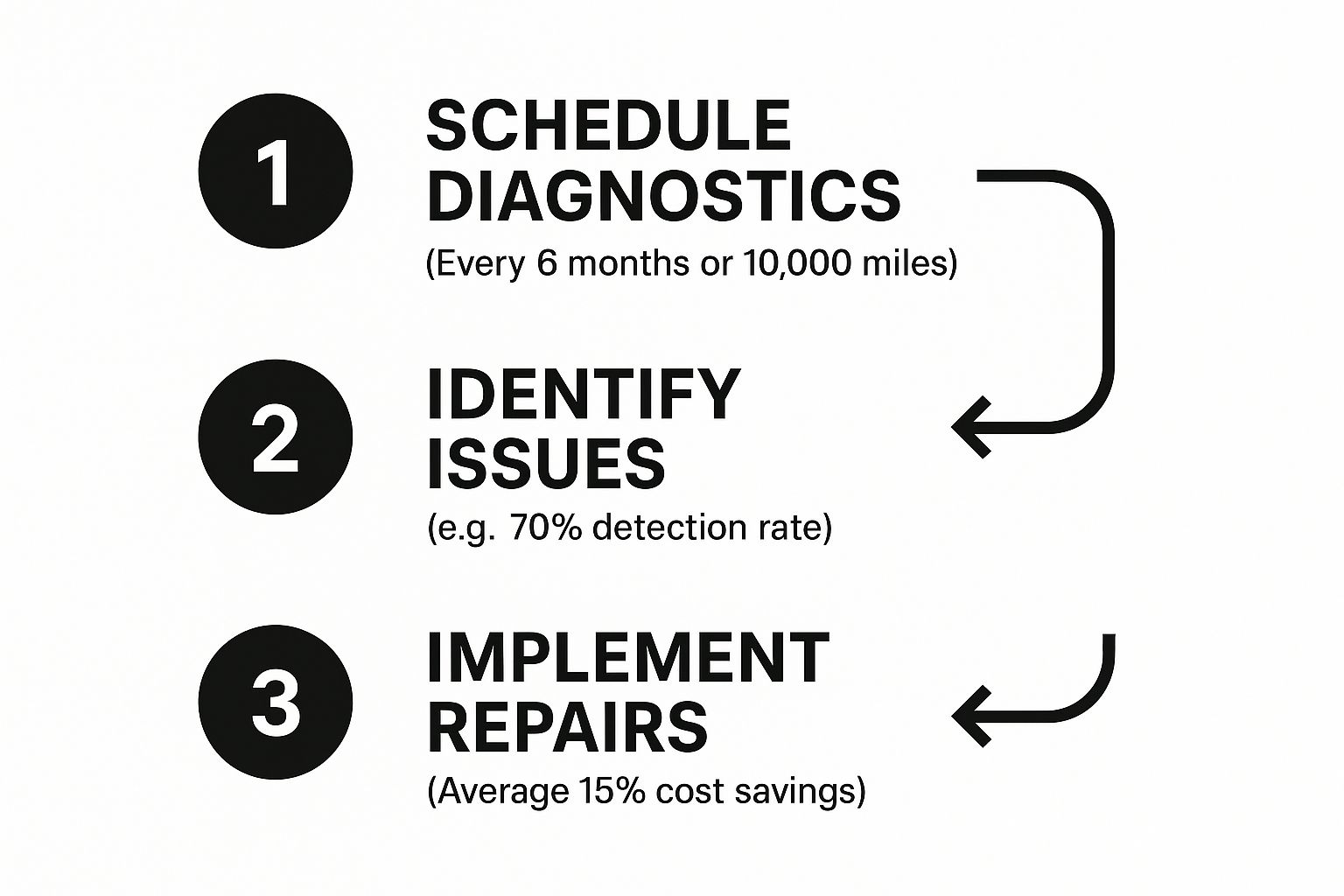
Beyond that, it's smart practice to have a full diagnostic scan done at least once a year, usually when you bring your car in for its annual service. This proactive approach lets us spot small, underlying electronic faults before they snowball into bigger, more expensive mechanical headaches. It’s all about peace of mind.
Can Bosch Tools Diagnose All Car Brands?
Yes, and that’s one of the biggest reasons we rely on Bosch diagnostic systems. Their equipment is brilliantly designed to be compatible with a huge range of vehicles, covering the vast majority of European, Asian, and American manufacturers.
This incredible versatility is what makes Bosch tools an indispensable asset for an independent garage like ours. It allows our technicians to work confidently on almost any car that comes through our doors, using a single, reliable platform to get accurate results every time.
A quick but important note: A diagnostic check is not the same as an MOT. An MOT is the annual, legally required test to confirm your vehicle is roadworthy and meets basic safety standards. A diagnostic check goes much deeper, investigating the health of your car’s electronic systems—like the engine, transmission, and safety modules—to pinpoint specific faults.
For an expert Bosch vehicle diagnostics check in Bedfordshire, you can count on the team at Krause Autos. We have the latest technology and the expertise to find the source of any problem, fast. Book your diagnostic appointment with us today.


Comments